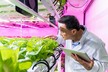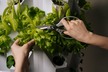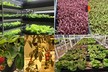


At the Philips GrowWise Research Center, researchers investigated how light and temperature strategies could improve the performance of crispy lettuce in terms of yield, quality, and shelf-life. Trials conducted with modern cultivars such as Crismina, Finstar, and Hydrolique demonstrated that contemporary crispy lettuce varieties can tolerate higher light levels and warmer temperatures without developing tip burn. Under these optimized conditions, yields were doubled compared to low-light, cool environments, and shelf-life was extended. The results indicate that growers can achieve both productivity and reliability in vertical farms by balancing light and temperature conditions effectively.
 © Signify
The demand for convenient, ready-to-eat lettuce continues to increase, prompting many growers to adopt shorter crop cycles, higher planting densities, and baby leaf–style harvests. Although this approach offers clear advantages, crispy lettuce has historically been considered difficult to cultivate due to its sensitivity to tip burn and inconsistent quality. Recent breeding developments have addressed these challenges. Modern crispy lettuce cultivars are significantly more tolerant to higher light levels and more resistant to tip burn, allowing growers to apply more intensive indoor growing conditions while maintaining quality.
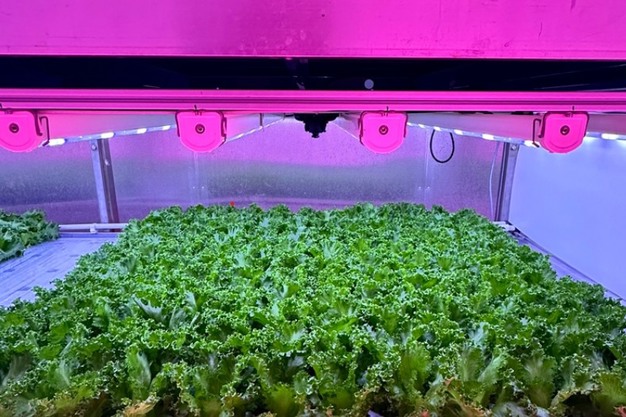
Researchers at the GrowWise Center tested six different light intensities, ranging from 180 to 480 μmol·s⁻¹·m⁻², and three temperature settings between 21 and 27 °C to analyze how plants respond to various combinations of light and heat. This relationship is described by the Radiation-Temperature Ratio (RTR), which reflects how efficiently plants convert light energy into growth under specific temperature conditions.
 © Signify
When light intensity is high but temperature is low, resulting in a high RTR, plants photosynthesize more sugars than they can use for growth due to slower metabolic activity. Excess sugars may be stored as starch or converted into protective compounds such as antioxidants, which can enhance shelf-life and stress resistance. Conversely, when light levels are low but temperatures are high, producing a low RTR, plants grow faster than sugars can be produced. While this can improve short-term growth efficiency, it often leaves plants with fewer reserves, reducing their strength and shelf-life. Achieving an optimal RTR is therefore essential to producing lettuce that is both high-yielding and of high quality, with improved taste, nutrition, and storage potential.
The research produced several key findings. Yield increased by up to 50 percent when light intensity was raised at a constant temperature, and by up to 33 percent when temperature was increased at a fixed light level. When both factors were optimized, yields doubled compared to the lowest tested settings of 180 μmol·s⁻¹·m⁻² at 21 °C. Higher light levels consistently elevated sugar concentrations in the leaves, although the influence of temperature on sugar content varied. Shelf-life remained at least 13 days under all conditions tested. These results demonstrate that by optimizing light and temperature balance, growers can achieve higher yields, more consistent quality, and longer-lasting, better-tasting lettuce suitable for modern supply chains.
For more information:
Signify
signify.com/global