

Inside a repurposed classroom at the Langston Hughes Community, Business & Resource Center in Park Heights, Baltimore, a compact vertical growing environment is doing double work: producing microgreens for the centre's food pantry while running workshops, youth sessions, and volunteer planting days for neighbourhood residents.
The Grow Well Vertical Farm is operated by What The Sprout, a food literacy organisation founded in 2023 by Quandra Gray, a former communications professional and adjunct instructor who shifted her focus to community agriculture after more than 15 years in design and marketing. "I traded PowerPoint for plants," Gray said. "I built a whole business where I teach everyday people how to play in the dirt, grow their own food, and use plants as medicine."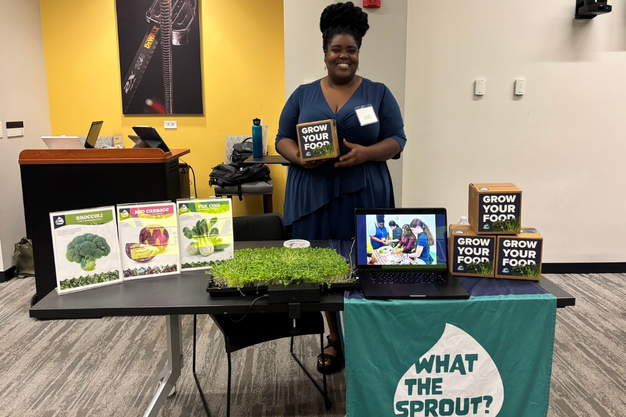 © What The Sprout
Microgreens as entry point
What The Sprout built its programming around microgreens because of the crop's practical advantages for beginners and constrained growing environments. Varieties such as broccoli can be sown and harvested in seven to fourteen days, require minimal equipment, and grow reliably indoors under basic lighting conditions. "Microgreens are perfect to teach children or a community that wants to learn how to grow their own food because they grow really fast."
Since 2023, What The Sprout has delivered programming to more than 450 residents and 65 youth across Baltimore through workshops, school contracts, and community events. The Langston Hughes site represents the organisation's first permanent indoor growing environment, converting previously unused interior space into a cultivation and training setting that operates year-round.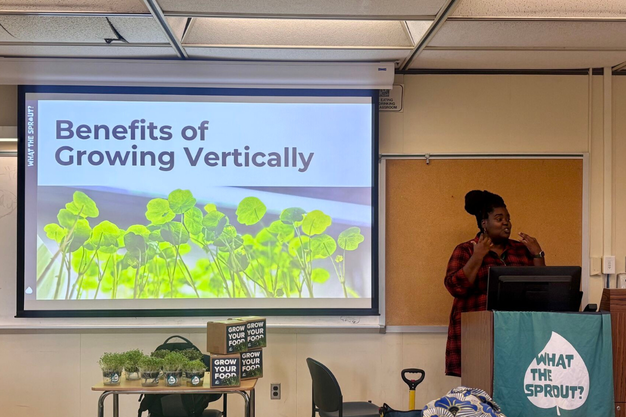 © What The Sprout
A pilot within a community institution
The Grow Well Vertical Farm functions as the first location in What The Sprout's Grow Well Pathways model, which connects indoor cultivation with nutrition awareness, environmental literacy, and green-career exposure. Rather than operating as a standalone production facility, the site is embedded within an existing neighbourhood institution that already serves residents through workforce development, business incubation, and community programming.
Microgreens harvested at the site have been distributed through the centre's food pantry programme. Towson University's Office of Civic Engagement and Social Responsibility has supported the operation, with civic engagement students participating in sowing sessions ahead of pantry distributions. A $20,000 small-business grant from Hello Alice, Baltimore Gas and Electric, and the Global Entrepreneurship Network contributed to the organisation's expansion and supported development of the indoor pilot environment.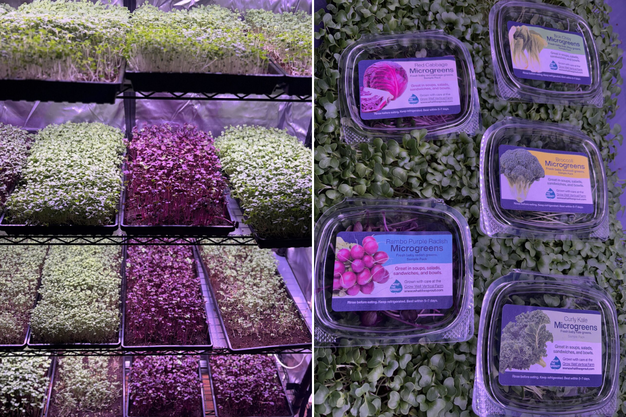 © What The Sprout
Connecting cultivation to environmental health
For CEA practitioners, community-embedded microgreens operations like the Grow Well pilot represent a distinct category within the indoor farming ecosystem: education-led environments where controlled growing conditions serve instructional and food access goals rather than commercial output targets. The case for these sites within the broader CEA sector rests on their ability to build agricultural literacy at neighbourhood scale, creating a pipeline of residents familiar with indoor growing systems before larger production infrastructure arrives.
Gray is currently participating in a fellowship with the Center for Engagement, Environmental Justice and Health, which she describes as grounding the Grow Well model in environmental justice frameworks and community science evaluation. The fellowship adds a formal assessment layer to the pilot's food access, heat resilience, and community health outcomes.
"Agriculture is the foundation of self-sufficient communities," Gray said. "I find it really critical that children at least once rear a plant to harvest, because it's a skill they will never lose."
For more information:
What The Sprout  © What The Sprout
Quandra Gray, Founder
[email protected]
www.whatthesprout.com